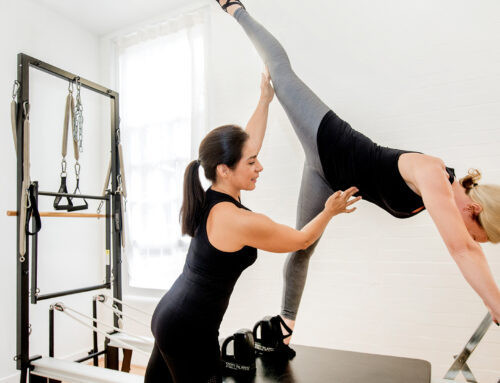
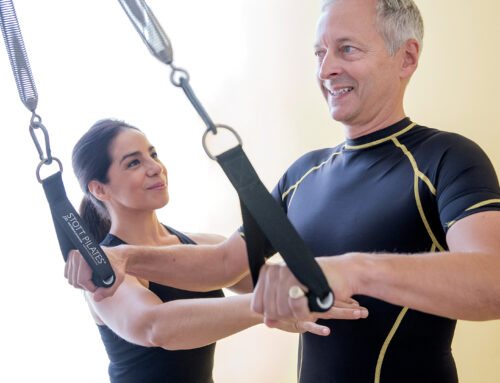
If you’re researching Pilates studios in London, you’ve probably noticed that not all Pilates is the same. At InnerCore in Chelsea, we specialize in the STOTT PILATES® Reformer method—a contemporary approach that differs significantly from classical Pilates. Understanding these differences helps you make an informed choice about where to invest your time and money.
The Evolution from Classical to Contemporary
Joseph Pilates developed his original method in the early 20th century. His work was revolutionary, creating exercises that built strength, flexibility, and body awareness. However, Pilates was working with the anatomical and biomechanical knowledge available at that time.
STOTT PILATES, developed in the 1980s by Moira and Lindsay Merrithew, maintains the essence of Joseph Pilates’ work while incorporating modern exercise science, spinal rehabilitation research, and contemporary understanding of functional movement patterns.
Five Foundational Principles
The STOTT method is built on five basic biomechanical principles: breathing technique that engages core muscles, pelvic placement in neutral rather than forced tucking, rib cage placement for proper torso stability, scapular movement and stabilization, and head and cervical spine positioning.
These aren’t just technical details—they’re the foundation for movement that’s both safe and effective. During your sessions at our Chelsea studio, you’ll notice how much attention we pay to these principles before adding complexity or resistance.
Respecting Your Spine’s Natural Curves
One significant distinction of STOTT PILATES is its approach to spinal alignment. Rather than flattening your lower back or forcefully tucking your pelvis, we work with your spine’s natural curves. Your spine has curves for biomechanical reasons—they absorb shock, distribute forces efficiently, and allow optimal movement.
Training in neutral spine creates more functional strength. You’re learning to stabilize in positions you actually use in daily life, not just on the reformer.
Three-Dimensional Movement Patterns
Life doesn’t happen in one plane. You bend, twist, reach, and move in multiple directions throughout your day. STOTT PILATES reflects this reality by incorporating exercises in sagittal (forward/back), frontal (side-to-side), and transverse (rotational) planes.
This comprehensive approach creates better overall strength and prepares your body for varied real-world demands. Whether lifting a child, reaching for something overhead, or maintaining balance on a crowded tube, you’re using functional strength developed through three-dimensional training.
Modern Research Integration
The STOTT method continuously evolves based on current research in biomechanics, motor learning, and rehabilitation science. The exercises and cueing we use aren’t based solely on tradition—they’re informed by latest understanding of how bodies move, learn, and adapt.
For clients across London seeking evidence-based fitness, this scientific foundation provides confidence that their investment is supported by research, not just historical precedent.
Why This Matters for Your Results
Quality instruction matters more than methodology alone. However, the STOTT approach offers particular advantages: reduced injury risk through proper alignment, more effective exercises based on modern science, functional strength that transfers to daily activities, and systematic progression for measurable improvement.
Our clients throughout the South East choose InnerCore not just for our convenient Chelsea location, but for the expertise and methodology that creates real, lasting results.
At InnerCore, experiencing the STOTT difference begins with your first session. You’ll feel how precise cueing and attention to alignment changes the quality of every movement. This isn’t just exercise—it’s education in how your body works and how to move it optimally. Your first session is free, providing an opportunity to discover what sets our approach apart.