In a world that seems to move faster every year, stress has become our constant companion. We carry it in our shoulders, our jaws, our breath. We lie awake thinking about tomorrow’s meetings and yesterday’s conversations. We feel simultaneously exhausted and wired, unable to truly relax even when we have the chance.
What if the answer isn’t adding more self-care routines to your already packed schedule, but finding a practice that addresses both physical fitness and mental wellbeing simultaneously?
The Physical Manifestation of Stress
Stress isn’t just “in your head.” When your nervous system is in a constant state of activation, your body responds. Your shoulders creep up towards your ears, your breathing becomes shallow and rapid, your jaw clenches unconsciously, and your muscles hold chronic tension that never fully releases.
Over time, this physical stress response contributes to headaches, digestive issues, disrupted sleep, and persistent muscle pain. You might not even realise how much tension you’re carrying until someone points it out or you finally experience what true relaxation feels like.
Why Traditional Exercise Sometimes Doesn’t Help
You might assume that any physical activity would help with stress relief, and to some extent, that’s true. Movement does release endorphins and provides a temporary outlet for nervous energy. However, high-intensity workouts can actually amp up your already activated nervous system, especially if you’re in a chronic state of stress.
Pounding through a HIIT session or pushing yourself to exhaustion might feel productive in the moment, but it can leave you feeling more depleted than restored. Your body doesn’t differentiate between the stress of your work deadline and the stress of sprinting, it all activates the same physiological response.
The Pilates Difference
Pilates, particularly when practised with attention to breath and body awareness, offers something fundamentally different. It’s challenging enough to fully occupy your mind, you can’t think about your inbox when you’re focusing on maintaining pelvic stability during leg circles, but gentle enough to allow your nervous system to downregulate.
At InnerCore, our approach centres on breathing as the foundation of every movement. This isn’t coincidental. Your breath is the most direct way to communicate with your nervous system. Slow, deep, rhythmic breathing activates your parasympathetic nervous system, the “rest and digest” response that counteracts stress.
When you coordinate breath with movement, you’re essentially practising moving meditation. You’re present with your body, noticing sensations, making adjustments, and letting go of the mental chatter that usually dominates your day.
The Mind-Body Connection in Practice
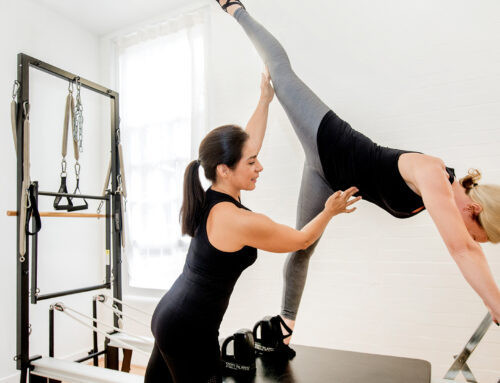
During a Reformer Pilates session in our Chelsea studio, you’re constantly receiving feedback from your body. You feel the springs engage, sense the carriage moving beneath you, and notice where you’re holding unnecessary tension. This creates an opportunity to consciously release that tension, developing the ability to recognise and let go of stress patterns.
Many of our clients describe their sessions as the only hour in their week when they’re truly present. Your mind has a task, controlling these movements with precision, which prevents it from wandering to stressors. But unlike a demanding workout that leaves you frazzled, you finish feeling centred and calm.
The private 1to1 format enhances this experience. There’s no performance anxiety, no comparing yourself to others in a group class. It’s just you, your instructor, and your body. This creates a safe space where you can truly let go and focus inward.
The Lasting Benefits
The stress-relief benefits of Pilates extend far beyond the studio. Regular practice teaches you body awareness that carries into your daily life. You start noticing when you’re holding tension in your shoulders during a stressful meeting. You remember to breathe fully rather than taking shallow chest breaths. You become more attuned to what your body needs.
Our clients frequently report improvements in sleep quality, feeling more equipped to handle daily stressors, reduced anxiety, better emotional regulation, and a general sense of being more grounded and less reactive.
These changes happen because Pilates doesn’t just address symptoms, it retrains your nervous system’s baseline. You’re teaching your body that it can be challenged without going into fight-or-flight mode. You’re proving to your nervous system that it’s safe to relax.
Creating Your Practice
If stress has taken up residence in your body and mind, Pilates might be exactly what you need, not as another obligation on your to-do list, but as an investment in your overall wellbeing. At InnerCore in London, we create programmes that challenge you physically while nurturing you mentally and emotionally.
Your first session is an opportunity to experience this for yourself, to discover what it feels like when your mind is quiet, your body is engaged, and stress loosens its grip, even if just for an hour. That hour might be the most valuable one in your week.