If you’re reading this on a screen right now, take a moment to notice your posture. Are your shoulders creeping towards your ears? Is your head jutting forward? You’re not alone. The modern workplace has created a posture epidemic, and it’s affecting far more than just how we look.
The Real Cost of Poor Posture
Sitting at a desk for eight hours a day doesn’t just cause temporary discomfort, it creates lasting changes in your body. Over time, certain muscles become chronically tight while others weaken from disuse. Your hip flexors shorten, your glutes switch off, and your upper back rounds forward.
This muscular imbalance can lead to persistent lower back pain, tension headaches, reduced lung capacity, and even digestive issues. Poor posture also affects your confidence and how others perceive you. But perhaps most concerning is how it limits your body’s ability to move freely and without pain.
Why Standard Exercise Often Isn’t Enough
You might think that going to the gym or doing yoga a few times a week would counteract all that sitting. Unfortunately, if you’re exercising with poor postural habits already ingrained, you’re often just reinforcing those patterns.
This is where the precision of Pilates becomes invaluable. Rather than simply getting your heart rate up or breaking a sweat, Pilates in London studios like InnerCore focuses on how you’re moving. Every exercise is an opportunity to retrain your body’s default positioning.
How Reformer Pilates Addresses Postural Issues
The STOTT PILATES® Reformer methodology we use is particularly effective for postural correction because it’s built on principles of optimal alignment. We work on pelvic placement, rib cage placement, and scapular movement, essentially teaching your body where it should be in space.
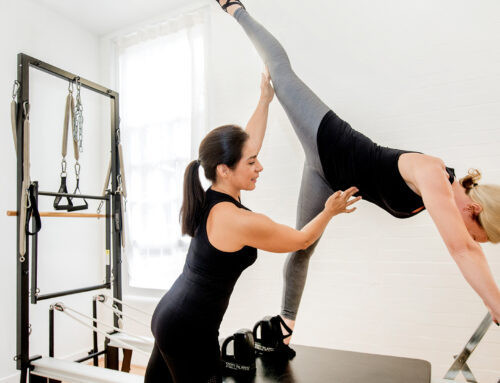
The reformer machine itself provides feedback that you simply can’t get from mat-based exercises. The springs offer resistance that challenges weak muscles while the moving carriage requires stability from your core. You can’t cheat your way through a reformer exercise, your body either maintains proper alignment or the movement falls apart.
In our private 1to1 sessions, your instructor can immediately spot and correct postural deviations. Are you arching your lower back to compensate for tight hip flexors? Gripping your shoulders when your core should be working? These patterns get addressed in real-time, creating new neuromuscular pathways that carry over into your daily life.
The Exercises That Make a Difference
While every Pilates session is tailored to individual needs, certain exercises are particularly powerful for reversing desk-work posture. Exercises that open the chest and strengthen the upper back help counteract rounded shoulders. Hip flexor stretches and glute activation work addresses the effects of prolonged sitting. Core stabilisation exercises protect your spine and improve overall posture.
What makes these exercises effective isn’t just the movement itself—it’s the attention to breath, alignment, and body awareness that accompanies each repetition. You’re not just going through motions; you’re fundamentally changing how your body functions.
Beyond the Studio
The goal isn’t just to have good posture during your Pilates classes, it’s to carry that awareness into everything you do. Our clients often report noticing their posture throughout the day: adjusting how they sit at their desks, becoming aware of tension they’re holding, and naturally correcting their alignment.
This increased body awareness is one of the most valuable outcomes of consistent Pilates practice. You develop an internal sense of what proper alignment feels like, making it easier to maintain throughout your day.
Getting Started
If you’re in the South East and dealing with the physical consequences of desk work, addressing your posture through Reformer Pilates might be one of the best investments you make in your health. At InnerCore, we begin with a postural analysis in your first session, identifying your specific imbalances and creating a programme designed around your needs.
You don’t have to accept poor posture as an inevitable consequence of modern life. With the right approach and expert guidance, you can reverse years of postural decline and rediscover what it feels like to move freely and without pain.